
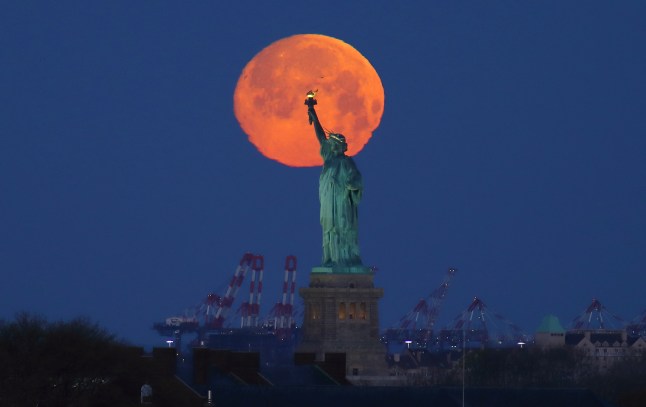
Don’t worry,you’re not colour blind. The moon isn’t literally pink (Picture: Gary Hershorn/Getty Images)
Night sky observers are being treated this month to a grab bag of intergalactic delights.
A novel moon that occurs just once a year,a newly discovered comet and being able to see a galaxy are just some of the things you can see in April.
The soonest will be the pink moon – here’s what you need to know.
No,it’s not a Barbie-themed moon. The pink moon is the name for the full moon that happens in April.
Every month’s full moon has a unique name if you look at The Old Farmer’s Almanac,the oldest almanac in the US,
It bestows names like last month’s worm moon or the full flower moon that occurs in May.
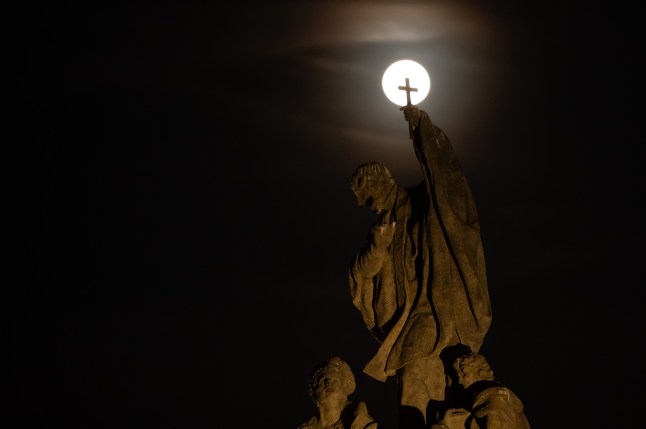
Every full moon has a name from the days when we used them to track the seasons (Picture: Marcos del Mazo/LightRocket via Getty Images)
No one for sure knows where these names come from,but folklore has it that those names came from the Algonquian,a Native American tribe.
By ‘pink’,the tribe meant this moon coincides with the sprouting of moss pink,a springtime wildflower.
Others know it as the Paschal moon,as it’s the first full moon after the spring equinox. People use it to determine when Easter will fall,which is always the first Sunday after the first full moon.
Thursday. It’ll be at its biggest and brightest,called the peak,at 03:12am.
‘If anything,it might be slightly orange as it rises because the moon tends to be a bit more orange when very low in the sky because we are looking at it through a shallow angle in our atmosphere,’ Kerry Voskou,of the Astronomical Society of Haringey (ASH),a club in London,told Metro.
‘As our atmosphere scatters blue light anything seen at a shallow angle tends to appear slightly redder.’
It’ll even look larger because of this,a phenomenon called a ‘moon illusion’.
Out of everyone,the four astronauts taking a trip to the moon and back as part of Nasa’s Artemis II mission will get the best view.
Scotland and Northern Ireland will have the best view,with clear skies forecast. It’ll be cloudy and rainy elsewhere,however.
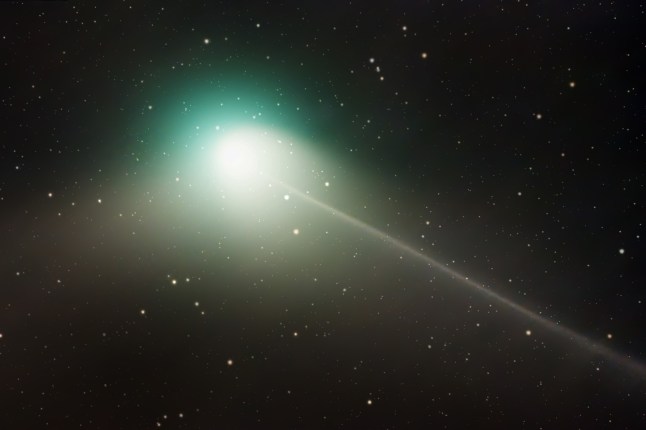
Comets are gigantic snowballs (Picture: Getty Images)
A lot! Comet MAPS (C/2026 A1) is next in this month’s astronomical calendar.
Comets are frozen chunks made of ancient ice that formed from the birth of the solar system.
MAPS is a Kreutz sungrazer,where it’ll pass very close to the sun. As it drifts just 101,000 miles away from our star,the comet will melt,causing the snowball to sprout a wispy tail.
While MAPS has a good chance of disintegrating completely,if it survives the ride,it’ll appear as a bright,twinkling speck from April 4. The next day,though,is your best shot until the comet vanishes on April 15.
The comet,which was discovered in January,will mainly streak across the low horizon of the UK night sky. So make sure no trees or buildings.
‘The best I can suggest is that during the first week of April,you look west after sunset and hope that there’s something there!’ says Kerry Voskou.
‘If there is,it will be somewhere below what appears to be a bright star but is in fact the planet Venus.’
If you miss it,the comet will reappear between April 19 and 26 as a fuzzy smudge.
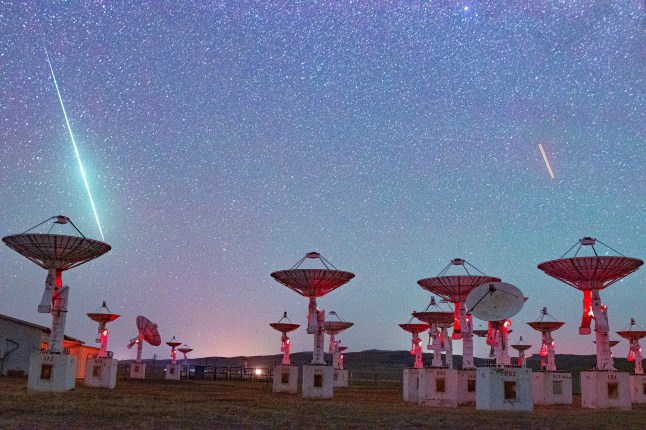
The Lyrid meteor shower observed from the Mingantu Observing Station of National Astronomical Observatories (Picture Zhang Gang/VCG via Getty Images)
Another big cosmic event is the Lyrid meteor shower,which runs from April 14 to 30.
Meteor showers are cosmic fireworks that streak brightly across the night sky, often visible with the naked eye. The Lyrids are the dusty debris from a comet named Thatcher.
Peak conditions will be overnight from April 21 to 22.
You should be able to crane your neck and spot the Whirlpool Galaxy,our interstellar neighbour known for its spiral arms.
It’ll sit high in the sky around midnight for most of the month,looking like a sparkly smudge through binoculars and,well,a spiral to a telescope.
Voskou adds: ‘Forget about the Whirlpool galaxy – there are always galaxies about and even if this is a good time of year to see them,you need a telescope.
‘Even with binoculars,the best you’ll get is a very small fuzzy patch of light,and even then the chances are that it will be drowned out by light pollution unless you are in a dark-sky area.’
Finally,you’ll have a small window to see what is colloquially called a planetary parade,where the planets march across the sky.
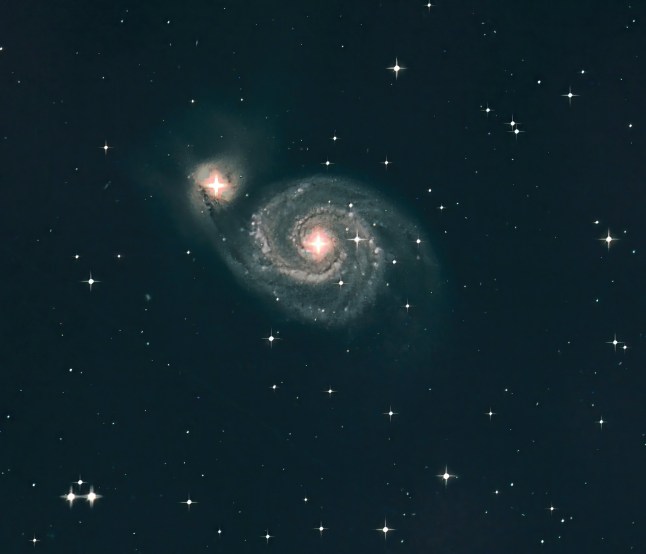
The Whirlpool is one of the most famous galaxies we’ve observed so far (Picture: Bryan Shaw / SWNS)
This happens because all the planets in the solar system orbit the sun in the same plane,so they always appear to travel the same path in the sky.
From about April 16 to 23,Mercury,Mars,and Saturn will appear cozy together.
You probably won’t need any observation equipment to see them,as they appear as tinted dots,but use apps like Stellarium to figure out when and where to look.
As with most stargazing,find a dark place with a clear view of the eastern horizon. If you live in or near a city,try light pollution map sites like this.
Get in touch with our news team by emailing us at .
Disclaimer: This article is reproduced from other media. The purpose of reprinting is to convey more information. It does not mean that this website agrees with its views and is responsible for its authenticity, and does not bear any legal responsibility. All resources on this site are collected on the Internet. The purpose of sharing is for everyone's learning and reference only. If there is copyright or intellectual property infringement, please leave us a message.
©copyright2009-2020New York Fashion News Contact Us SiteMap
